
CAPABILITIES
Injection Mold Tooling Strategy & Engineering Support
Injection Mold Tooling for Long-Term Production
Tooling strategy plays a critical role in the success of any injection molding program. Selecting the right mold design, tooling materials, and manufacturing approach helps ensure parts can be produced consistently and cost-effectively across the life of a product. Proper tooling planning also helps avoid costly redesigns or production delays later in the manufacturing process.Engineering Support for Injection Mold Design
Night Owl Manufacturing provides engineering support for plastic injection mold design, helping evaluate manufacturability before tooling begins. Our team reviews key design considerations such as:- part geometry and wall thickness
- draft angles and mold release
- material selection
- insert or overmolding requirements
- production volume expectations
This review helps ensure tooling is aligned with long-term manufacturing requirements.
Tooling Management for Injection Molding Programs
Night Owl Manufacturing supports tooling management for injection molding programs, coordinating mold design, manufacturing and supplier placement. Programs may involve domestic or overseas tooling partners depending on the product requirements and manufacturing strategy. By managing tooling strategy early, companies can reduce risk and ensure smooth transitions between prototype, bridge, and production programs.Single Source Injection Molding Support
Night Owl Manufacturing acts as a single point of accountability for injection molding programs. By managing engineering review, tooling strategy and supplier coordination, companies can move from prototype development to production with a consistent manufacturing partner overseeing the program.Start Your Injection Molding Program
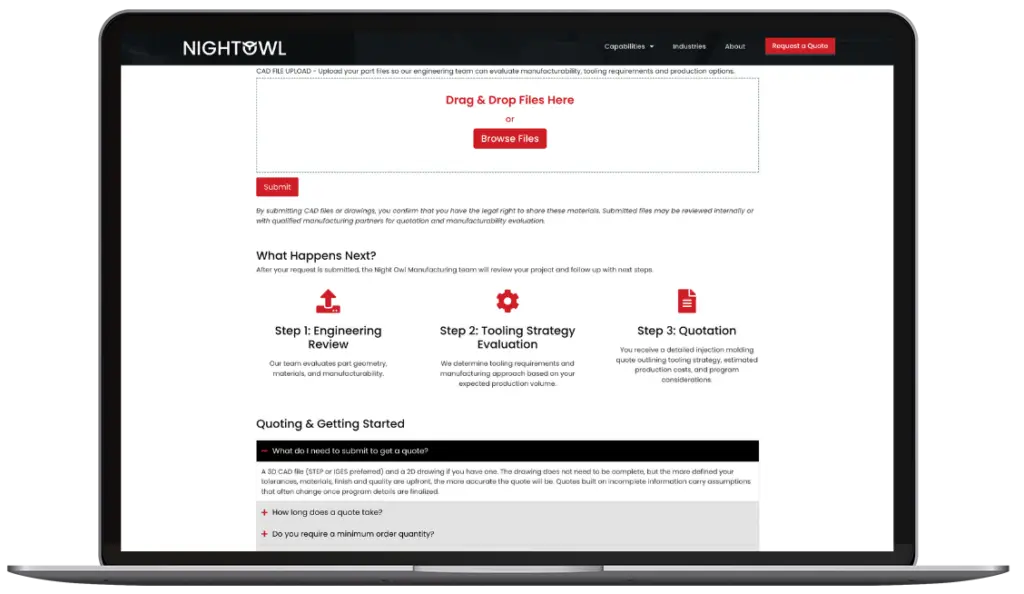
Upload your CAD files and the Night Owl Manufacturing engineering team will review your design, tooling requirements and production goals.
Supported Formats:
STEP • STP • IGES • SLDPRT • ZIP
Frequently Asked Questions
Who owns the tooling?
The customer owns the tooling. Night Owl builds and maintains the tool, but ownership transfers to the customer upon payment in full. Tooling can be transferred to another facility if the customer chooses, though we recommend a tool audit before any transfer to document condition.
Where is tooling built?
We work with vetted tooling partners domestically and offshore depending on program requirements, timeline, and budget. Domestic tooling carries shorter lead times and easier revision cycles. Offshore tooling carries lower upfront cost on larger, more stable geometry. We will recommend the right approach for your program — not the one that is easiest for us.
How long does tooling take?
Prototype and bridge tooling: 3–5 weeks typical. Production tooling: 6–10 weeks depending on complexity. Tools with side actions, hot runners, or high-cavitation configurations take longer. We do not quote lead times we cannot hold.
What is the difference between prototype tooling and production tooling?
Prototype tooling (also called soft tooling or bridge tooling) is built from aluminum or softer steel grades. It is faster and less expensive to build and modify but has a shorter tool life — typically 10,000–100,000 shots depending on material and geometry. Production tooling is built from hardened steel, carries a longer tool life (500,000–1,000,000+ shots), and is built to tighter tolerances. The right choice depends on your volume, timeline, and likelihood of geometry changes.
Can I modify the tool after it is built?
Yes, within limits. Adding steel to a cavity (making a feature smaller) is straightforward. Removing steel (making a feature larger) requires welding or inserting, which is more expensive and time-consuming. This is why DFM review before tool construction matters — geometry changes after steel is cut are always more expensive than geometry changes on a screen.
What happens to my tool if I don't place orders for an extended period?
Tools in storage are maintained and protected from corrosion. We will contact you before taking any action on a dormant tool. If a tool has been inactive for an extended period, a tool inspection and trial run may be required before returning to production to verify condition.
Do you accept transferred tooling from other molders?
Yes. All transferred tooling undergoes an incoming inspection before we commit to running it. We document tool condition, identify any maintenance required, and confirm the tool is capable of producing parts to print before the first production run. We do not run transferred tooling blind.
What is the difference between prototype, bridge, and production molding?
Prototype molding uses lower-cost tooling to produce small quantities for design validation, fit checks, and functional testing. Speed and iteration flexibility are the priority. Tolerances and cosmetics may not be at final production standard.
Bridge molding fills the gap between prototype validation and production tooling completion. It uses the prototype tool or a dedicated bridge tool to produce parts that meet production intent while the production tool is being built. Bridge parts are typically at or near production quality.
Production molding uses hardened steel tooling validated to production tolerances and process parameters. It is the stable, repeatable state a program is designed to reach.
When should I start thinking about production tooling?
As soon as geometry is stable. The lead time for production tooling is 6–10 weeks — that clock starts when the tool design is approved. If you wait until bridge inventory is exhausted to start the production tool, you will have a gap. We will flag this proactively on every bridge program we run.
Can you manage tooling for parts I source elsewhere?
Yes. Tooling management — storage, maintenance, repair, and qualification — is available for tools running in our facility regardless of where they were originally built.